A shingle roof does not fail because wind pushes on it. It fails because wind pulls, and the damage it leaves is a crease that lies flat again and reads as a perfectly good roof from thirty feet. That is why this one gets settled by hand, on the roof, slope by slope, with the photographs going into a file you keep.
Uplift, not impact
Air moving across a roof plane accelerates, and accelerating air drops in pressure. The result is a region of lower pressure sitting on top of the roof while ordinary pressure, plus whatever the attic is doing, pushes up from underneath. The net force is outward, away from the deck. Wind lifts a roof off a house; it very rarely presses one in.
That suction is not even across the plane. It concentrates at discontinuities, which on a house means the ridge, the rake edges where the roof meets a gable end, the eaves, and above all the corners. This is why a roof that lost material after a storm has usually lost it in a band along an edge rather than a patch in the middle of the slope, and why ridge cap is almost always the first casualty. The middle of a big plane is the safest real estate on the roof.
The seal strip, and why the month a roof was installed matters
Every asphalt shingle made for a residential roof carries a strip of thermally activated adhesive. When the roof warms in the sun, that strip softens and bonds each course down onto the one below it, so the finished roof behaves like a single laminated sheet rather than a stack of loose tabs. That bond, not the nails, is what resists uplift across the face of the shingle. The nails hold the top edge; the seal holds the bottom.
The consequence is seasonal. A roof laid in mid November in this metro may not get enough sustained warmth to seal properly until the following spring, and it sits through the winter more vulnerable than the same roof laid in July. Reputable installers know this and hand seal where conditions require it. It is also why a roof that is three months old and lost shingles in a wind event is worth looking at closely rather than assuming the storm was exceptional.
At the other end of a roof's life the same strip is the problem for the opposite reason. Asphalt loses volatiles and stiffens with age, the seal becomes brittle, and a fifteen or eighteen year old roof lets go at wind speeds that would not have troubled it when it was new. Wind does not damage roofs indiscriminately. It finds the ones that were already close.
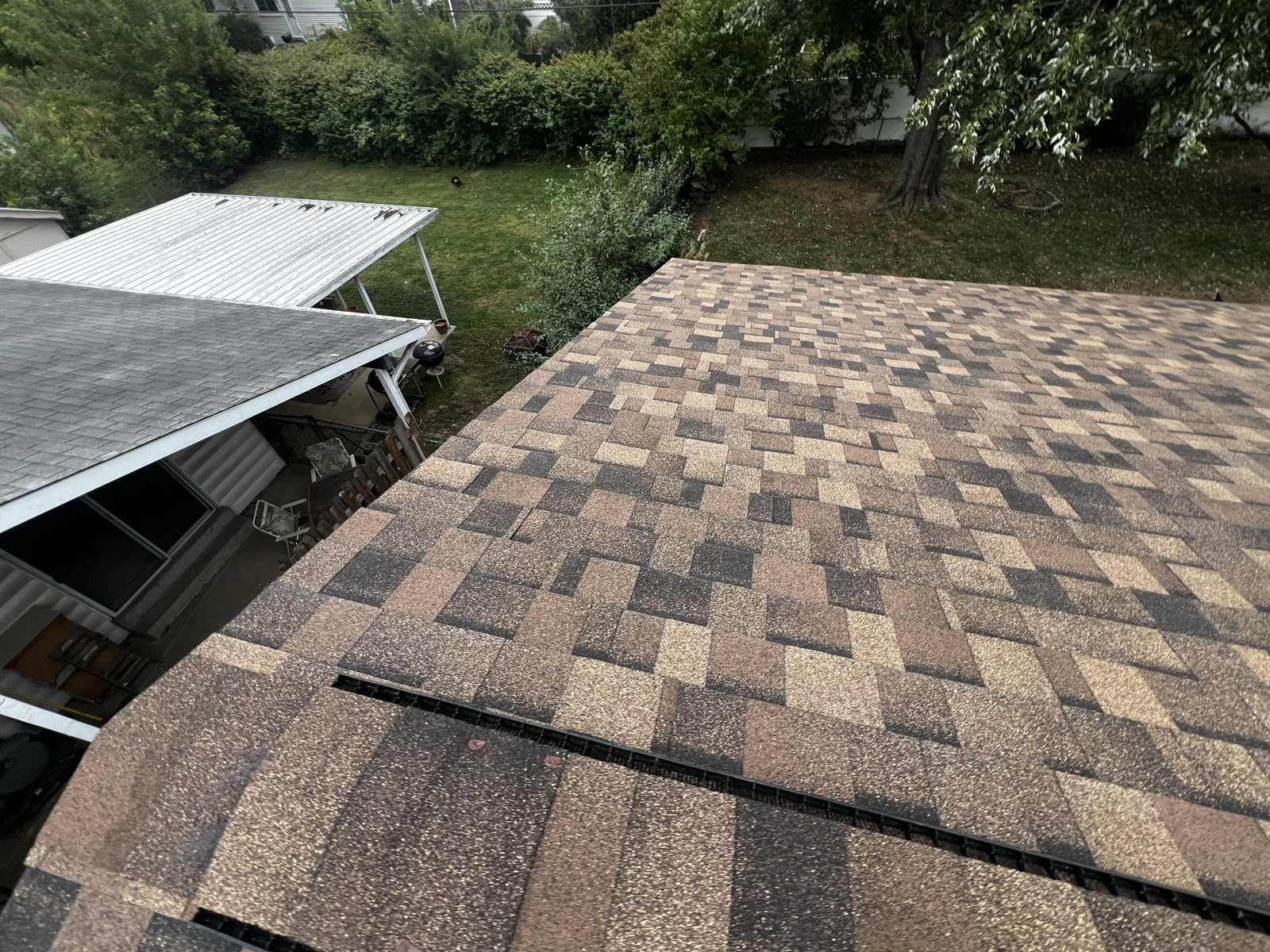
The crease, which is the whole subject
Here is the failure mode that costs people money because they cannot see it.
Wind gets under the leading edge of a shingle and breaks the seal. The tab lifts, folds back on itself towards the ridge, and then, when the gust passes, drops down again and lies more or less flat. From the ground, and often from the roof, the shingle looks fine. It is not fine. At the point where it folded, the fibreglass mat inside it has been bent past what it tolerates and is now cracked along a line running across the shingle. The granule surface at the fold is usually disturbed too, sometimes visibly and sometimes not.
That crease is a permanent defect. The shingle will let water past it eventually, and because the seal has been broken it is now the loose edge that the next storm gets under first. A field of creased but present shingles is a genuinely damaged roof that looks untouched, and it is the single most argued about finding in wind inspections anywhere.
The related, milder case is the shingle that lost its seal without creasing. It is intact, but it is no longer laminated to the course below, and it will lift again in the next event. Whether that is a repair or a whole roof depends entirely on how many of them there are and where.
The things that are obvious
- Missing tabs. Bare underlayment or bare deck showing in the shape of a shingle. Look at the yard and the neighbours' gardens: shingles travel.
- Ridge cap gone. Individual caps lifted or absent along the top of the roof, often the only visible damage after a moderate event.
- Exposed fastener heads. Where a shingle above has moved, the nails holding the course below are suddenly weather exposed. Every one of those is a slow leak that starts in about three years.
- Peeled drip edge or gutter apron. Thin metal along the eave folded up or away from the deck.
- Flashing lifted at a chimney or a sidewall. Wind gets into the vertical leg of a step flashing the same way it gets under a tab.
- A ridge vent lifted at one end. These are fastened along their length and a lifted end is both a leak and a piece of debris waiting to go.
What a wind rating on a shingle actually means
Shingles are tested to a wind rating under a defined laboratory procedure, on a specified deck, with a specified fastening pattern, with the seal fully set. That figure describes a test condition. It is not a promise about a gust across your particular roof, on a deck of unknown condition, on a roof plane with a big gable end facing west, with a seal that may or may not have set properly in the month it was laid. It is a useful comparative number and a poor absolute one, and the fastening pattern used on the day matters at least as much as the rating on the wrapper.
Keys installs Atlas and Malarkey shingles and nothing else, which at least means the question of what is on the roof and how it is meant to be nailed has a single, checkable answer.
Straight
Creasing is where inspectors and adjusters most often disagree in good faith, because a crease can look very like ordinary ageing and a roof usually carries some of both. Anybody who tells you the distinction is always obvious is overselling. What settles it is a photographed, slope by slope record made close to the date of the storm, and getting that made this week is the single most useful thing you can do about it.