Ask the company on your step one question before you sign anything: which municipality is my address in, and are you pulling the permit there. In the month after a storm a great many roofs in this county get replaced by crews who would rather not have that conversation, and the permit is the only part of the job that leaves a public record with your address on it.
The state level answer first, because it surprises people
Missouri has never adopted a statewide roofing licence. There is no state board, no state examination and no state number for a roofing contractor to hold. Bills to create one were filed in 2016, in 2019 and again in 2021, and every one of them failed. Anybody citing a state roofing licence law in Missouri is citing a bill that did not pass.
What that means practically is that the words licensed and insured, on their own, refer to whatever registration the local municipality requires and to the contractor's insurance. Both are worth confirming, and both are confirmed by asking for the certificate and by ringing the municipality, not by reading the side of a truck.
What St. Louis County generally requires
For unincorporated St. Louis County, the ordinary position on a residential asphalt roof is this. A like for like replacement of asphalt shingles on a slope of 4:12 or steeper does not by itself require a building permit. A permit is required if the slope is shallower than that, if more than a quarter of the roof decking is being replaced, or if the roofing material is changing to something else.
Those three exceptions are exactly the ones a storm produces. Limb strikes replace decking. A tear-off on an old house frequently finds far more soft board than anybody expected. And a homeowner who has just watched shingles leave the roof is precisely the person who starts asking about metal.
Which is why the decking clause is the one to read twice
Nobody knows how much decking is coming off until the shingles are off. A job that started as a permit free like for like replacement can cross the threshold on the second morning. A contractor who has thought about this will tell you in advance what happens if it does. A contractor who has not will either quietly carry on or present it as a surprise.
The municipality matters more than the county
This is the part that catches people out. St. Louis County contains a large number of separate municipalities, and many of them run their own building departments, their own permit requirements and their own contractor registration, entirely independent of the county's rules. Ballwin and Kirkwood, for instance, both operate their own contractor licensing.
So the correct question is never what does St. Louis County require. It is what does my city require, and the answer is a phone call to your own city hall. That call takes four minutes and it is the only reliable source, because requirements change and the neighbour's answer is about the neighbour's city.
If you are in St. Charles County the same instruction applies with more force. Published sources on the county's residential roofing permit requirements conflict with one another and the county's own guidance has not been reliably reachable, so this desk is not going to state a rule it cannot stand behind. Ring the county's division of building and code enforcement and ask them directly before you assume either way.
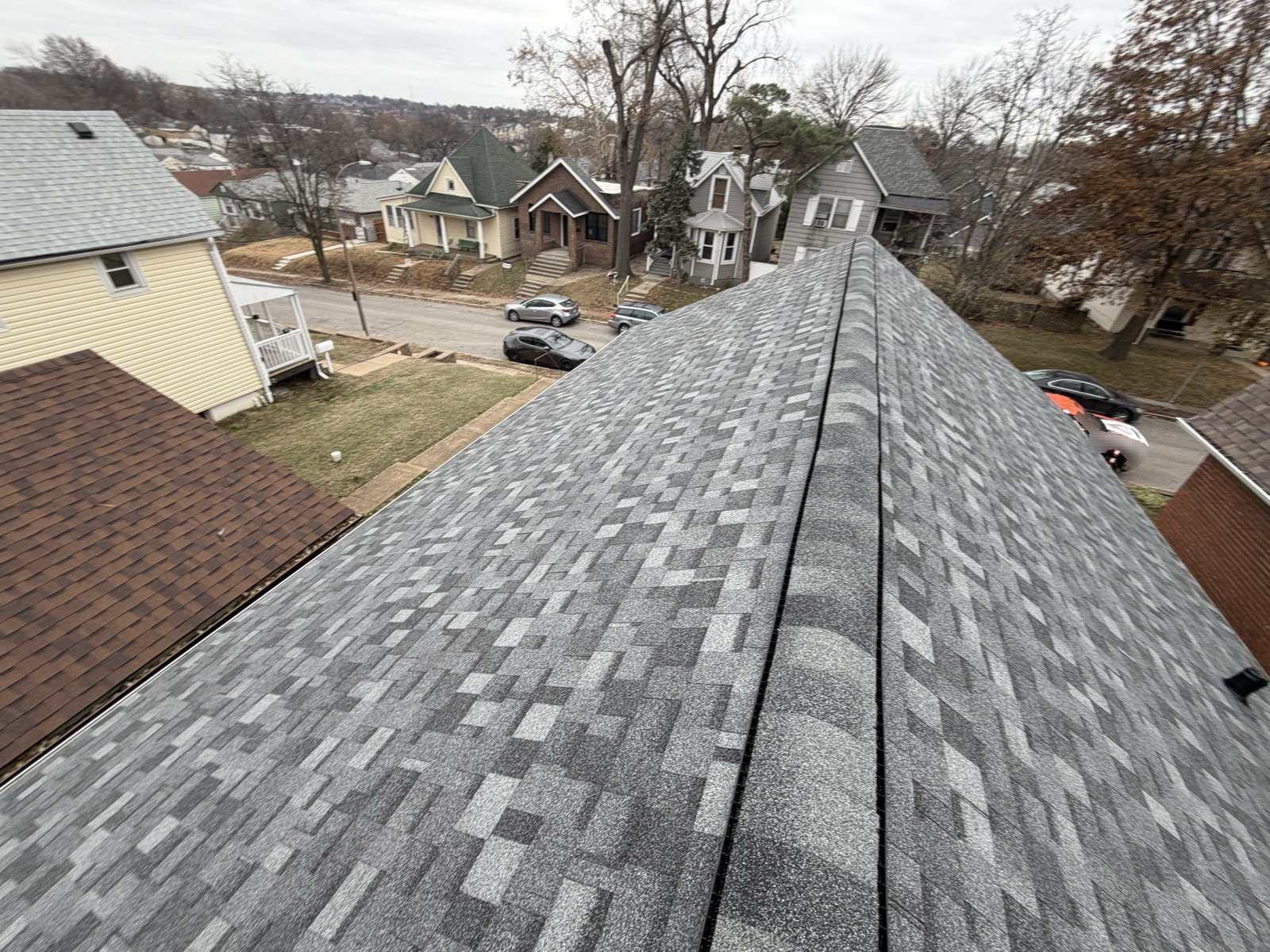
What a permit actually does for you
A permit is not a tax on being careful. It does three things a homeowner benefits from directly.
- It creates a public record that work was done on the roof, on a date, by a named contractor. That record outlives the contractor, which matters when a company that came in after a storm no longer exists in three years.
- It brings an inspection by somebody who does not work for the roofer. On a re-roof that inspection is not deep, but it is a second set of eyes with no financial interest in the answer.
- It travels with the house. Unpermitted work on a roof turns up at the worst possible moment, which is during a sale, and it turns up as the buyer's problem to raise and the seller's problem to solve.
Repair against replacement
A great many storm roofs need a repair rather than a replacement, and the permit position is generally more relaxed for a genuine repair than for a full re-roof. That is not a licence to describe a re-roof as a repair. It is a reason to be clear about which one is being proposed, in writing, before the work starts, because the two words describe different jobs, different money and different obligations.
Ordinances change and this county holds a great many separate jurisdictions, so confirm the detail with your own city. Keys will tell you on the phone which one you are in.