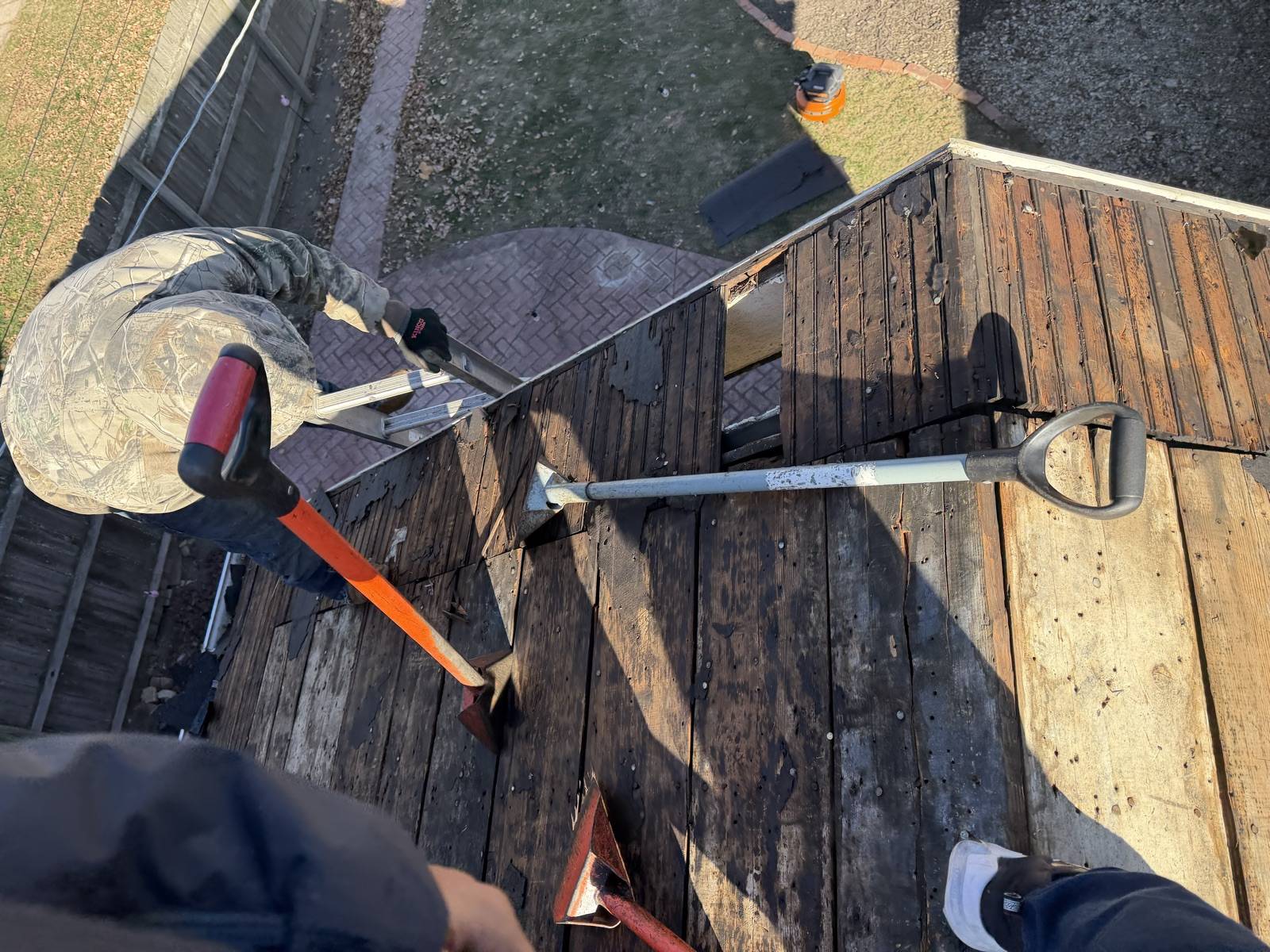
A storm roof is decided on paper long after the weather has gone, and the people who come out of it well are the ones who built the record in the first week. It is not difficult, it is just specific, and Keys will build the roof half of it for you: every slope photographed wide and close, measured, and written up as a scope you keep. Do the indoor half yourself tonight with a phone.
Photographs that are actually worth something
Most storm photographs on most phones are useless, for the same three reasons every time: no context, no scale and no date the viewer can trust. Fixing that costs nothing.
- Wide before close, every time. A frame showing the whole elevation, then the same feature closer, then the detail. Without the wide shot nobody can place the close one, and a close photograph of an unidentifiable piece of roof persuades nobody.
- One fixed landmark in frame. A chimney, a dormer, a vent, the corner of the house. It ties the close shot to the wide shot and it ties both to your address.
- Say which elevation. North, south, east, west, or front, back, garage side. Write it down as you go, because by Thursday you will not remember.
- Shoot the debris where it landed. Shingle tabs in the grass, ridge cap on the drive, a piece of flashing in the bed. Photograph first, tidy second.
- Include the neighbours' roofs and the street. Not for their sake. It establishes that a weather event crossed a block rather than one house.
- Let the phone keep its own timestamps. Do not screenshot, crop or re-save the originals. Keep them somewhere they will not be compressed away and do not delete the originals after sending them to anybody.
What belongs in a written scope
A scope is a document that says what is there, what is wrong with it, and what the repair consists of. A number scribbled on the back of a business card is not a scope, and neither is a one line estimate.
- Measurements slope by slope, with the pitch of each, and the total in squares
- How many layers of roofing are on the deck, and what the deck is made of where that could be established
- The condition of the flashing at every chimney, sidewall, valley and penetration, item by item
- Ventilation as it currently is: ridge vent, box vents, soffit, and whether the intake and exhaust are balanced
- Every penetration listed: pipe boots, flue collars, vent hoods, satellite mounts
- Gutters, downspouts, drip edge and gutter apron, described separately from the roof
- The damage found, by location, cross referenced to the photographs
- What the repair is, and what happens if the deck turns out to be soft once the shingles are off, because that is the one thing nobody can see in advance
That last line matters more than it looks. Deck condition is genuinely unknowable until the tear-off, and a scope that does not say in advance what happens when soft boards turn up is a scope that will produce an argument on the second morning.
The one line the law draws, in a sentence
A contractor shall not represent or negotiate, or offer or advertise to represent or negotiate, on behalf of an owner or possessor of real estate on any insurance claim in connection with the repair or replacement of roof systems. RSMo 407.725, Missouri Revised Statutes
That is the line and it is not a soft one. A separate subsection of the same statute forbids a roofing contractor to advertise or promise to absorb, rebate or waive any part of an insurance deductible, and a violation of either is an unfair practice under the Missouri Merchandising Practices Act. Any company on your step offering either one has told you what it is before it ever gets on the roof.
What Keys does instead is the part that actually moves a storm roof along, and it does it in days rather than weeks. Somebody climbs it, photographs every slope wide and close, measures it, writes down what was found and what the repair is, and hands you the file. When an adjuster comes out, the person who walked that roof is up there with them pointing at the thing being discussed. Most of the crews working your street this month cannot produce any of that, and every conversation and decision past that point is yours.
If you want somebody who can genuinely act for you
That role exists and it is a public adjuster, a separate licensed profession regulated under chapter 325 of the Missouri statutes. Missouri does not cap what a public adjuster may charge, so the fee is a matter for the contract and worth reading carefully. RSMo 325.055 bars a public adjuster from also performing the repair work, which is deliberate: the person arguing about the scope is not allowed to be the person who profits from the scope.
Two Missouri rules worth knowing before anybody hurries you
The limitation period for bringing an action on a written contract in Missouri, which includes an insurance policy, is ten years under RSMo 516.110(1). Separately, RSMo 431.030 makes a contract term that shortens the time for bringing suit null and void, so a clause in a policy purporting to give you one or two years to sue does not do what it appears to do in this state.
None of that is a reason to be slow. Evidence decays, memories go and the next storm crosses the same street. It is a reason not to be panicked into a decision by somebody implying a deadline that is not there.