Hour zero to day seven in the order it has to happen, and the one move that decides how the rest of it goes: a documented inspection on day two, not day twenty.
Photograph the inside of the house tonight, walk the perimeter from the ground at first light, and get somebody on the roof with a camera by day two. That order is the whole difference between the version of this week that ends calmly and the version where a person signs something at nine in the morning that costs them a great deal by August. It is almost never about how bad the roof was.
What follows is that order. Some of these entries are five minutes of work. One of them is fifteen minutes of reading that most people skip and later wish they had not.
H+00
While it is still blowing
Stay inside and stay off the ladder. This is not caution for its own sake: the specific hazard at hour zero is that a roof which has just lost its seal is a sheet of loose material on a slope, and the second hazard is anything electrical that came down with a branch.
What you can usefully do is put containers under active drips, move furniture and papers out from under a wet ceiling, and photograph the inside of the house while it is actively leaking. An interior photograph taken during the storm, timestamped by your own phone, is a far better record than one taken on Saturday when the drip has stopped and all that is left is a stain.
If a ceiling is bulging, that is the one thing worth acting on immediately, and there is a right way to do it, which is on the water inside the house page.
H+01
First light, from the ground, all the way round
Walk the whole perimeter before you touch anything. Start with a wide photograph of each elevation from far enough back that the whole roof plane is in frame, then move in for the details. The wide shots are what let anybody later work out which slope a close-up belongs to.
Things worth a frame of their own: shingles or ridge cap lying in the yard or the drive, a gutter hanging off its hangers at one end, a downspout crushed or torn away, a limb resting on the roof, a piece of flashing in the flowerbed, and the neighbours' roofs, because the direction the block took damage in tells the story better than your house alone does.
Pick nothing up until it is photographed where it landed. A tab of shingle in the grass is evidence of which slope it came off; the same tab in a bin bag is rubbish.
H+03
Go into the attic with a torch
The attic is the only place a homeowner can safely inspect the underside of the roof, and after a wind event it is genuinely informative. You are looking for daylight, which means something is gone; for wet insulation or a dark stain on the decking, which means water came through; and for anything blown into the space through a ridge vent or a gable vent.
Do this in daylight, because daylight coming through a gap is the easiest thing in the world to see from a dark attic and impossible to see at night. Watch your footing on the joists, and if the insulation is soaked in a patch, photograph it and leave it alone.
H+06
Decide the one question that sets the pace: is the roof open?
Open means water can get in during the next rain. Bare decking showing where shingles used to be, a torn or missing pipe boot, ridge cap gone along a length of ridge, a hole from an impact, flashing peeled away from a chimney or a wall.
If the answer is yes, this is a same day call and probably a tarp, and the weather forecast is now the most important document in the house. If the answer is no, you have bought yourself time and should use it: an unhurried inspection on Thursday is a better inspection than a rushed one tonight.
The one hazard that overrides everything above
If a wire is down anywhere on the property, or a limb is resting on the service line where it comes into the house, or the mast that carries that line has been pulled loose from the wall, do not go near any of it and do not put a ladder up. Assume every downed conductor is live, keep away from puddles near it, ring the utility, and leave the roof entirely alone until they have been. No roof repair is urgent enough to be worth this.
DAY 1
Read your own policy before anybody hands you a contract
This is the fifteen minutes almost nobody does, and it is the highest return quarter hour of the week. Four things to find, in this order.
The deductible, and whether it is a flat figure or a percentage of the dwelling coverage. A percentage deductible on a wind or hail loss is common in this state and it can be a very different number from the one people carry in their heads.
Replacement cost or actual cash value on the roof. Some policies settle a roof on a depreciated basis, or on a schedule that depreciates by age. This single line changes the arithmetic of the whole decision.
The condition about protecting the property from further damage. Most homeowners policies contain one. It is the reason temporary protection and receipts matter, and it is written in plain enough English to read once.
Any cosmetic damage exclusion or wind and hail endorsement that alters how a roof loss is handled. If one is in there, it is usually in a short endorsement rather than in the main body.
You do not have to become an expert. You only have to have read it before somebody in your driveway starts telling you what it says.
DAY 1
The knock, and the two things that are hard to undo
Crews will drive the block. Some of them are good local companies doing exactly what a local company should do after a storm. Some of them followed the radar in from three states away and will not be here in November.
Two pieces of paper deserve a slow read. The first is anything described as a contingency, an authorisation to inspect, or a direction to pay: read what it commits you to if a claim is approved, whether it names a fixed price or defers to an insurer's figure, and what it costs to walk away. The second is any document that assigns rights under your policy to a contractor. Neither is automatically sinister and both are worth understanding before a signature rather than after one.
And if the offer includes anything at all about your deductible, that alone is disqualifying, because RSMo 407.725 bars a roofing contractor in Missouri from advertising or promising to absorb, rebate or waive any part of it.
DAY 2
A documented inspection, and what you should hold at the end of it
Somebody goes up who does this for a living. What comes back down should be photographs of each slope, measurements slope by slope, a note of the number of layers and the condition of the decking where it could be seen, the state of the flashing and the penetrations, and a written scope describing the repair. You keep a copy of all of it.
A verbal number shouted from a ladder is not an inspection. Neither is a photograph of somebody else's roof. If a written scope is not on offer, that is information.
DAY 3
Temporary protection, if the roof is open and the permanent repair is not tomorrow
A tarp is not a repair and it does not last the summer. What it does is keep the deck from getting wetter while the rest of this takes its course. The mechanics, the honest lifespan, and the four situations where tarping is the wrong answer are on the tarping page.
DAY 5
Look again at everything you decided was fine
Two things change between day one and day five. The first is that adrenaline wears off and people notice things they walked past. The second is that a roof which was merely unsealed on Tuesday has now had three more days of sun and wind on it, and a shingle that was creased but lying flat is often visibly lifted by the end of the week.
Walk the perimeter again with the day one photographs on your phone and compare. It takes ten minutes and it regularly finds something.
DAY 7
The ceilings, the basement and the gutters
Water moves slowly through insulation and drywall. A stain that was not there on Tuesday appears on Sunday, generally somewhere that seems unrelated to where the roof is open, because water runs along a rafter before it drops. Check every ceiling and the top of every interior wall.
Then check the basement, and then check the gutters, because those two are the same story. A storm dumps a season of debris into a gutter in twenty minutes. A blocked gutter overflows against the wall and puts the roof's entire volume of water at the foundation, which is where a surprising number of post storm basement problems actually come from. That whole subject has its own page.
One thing worth hearing early: sometimes the roof lost eleven shingles and needs eleven shingles, and Keys will say so in your driveway rather than sell you a replacement you did not need.
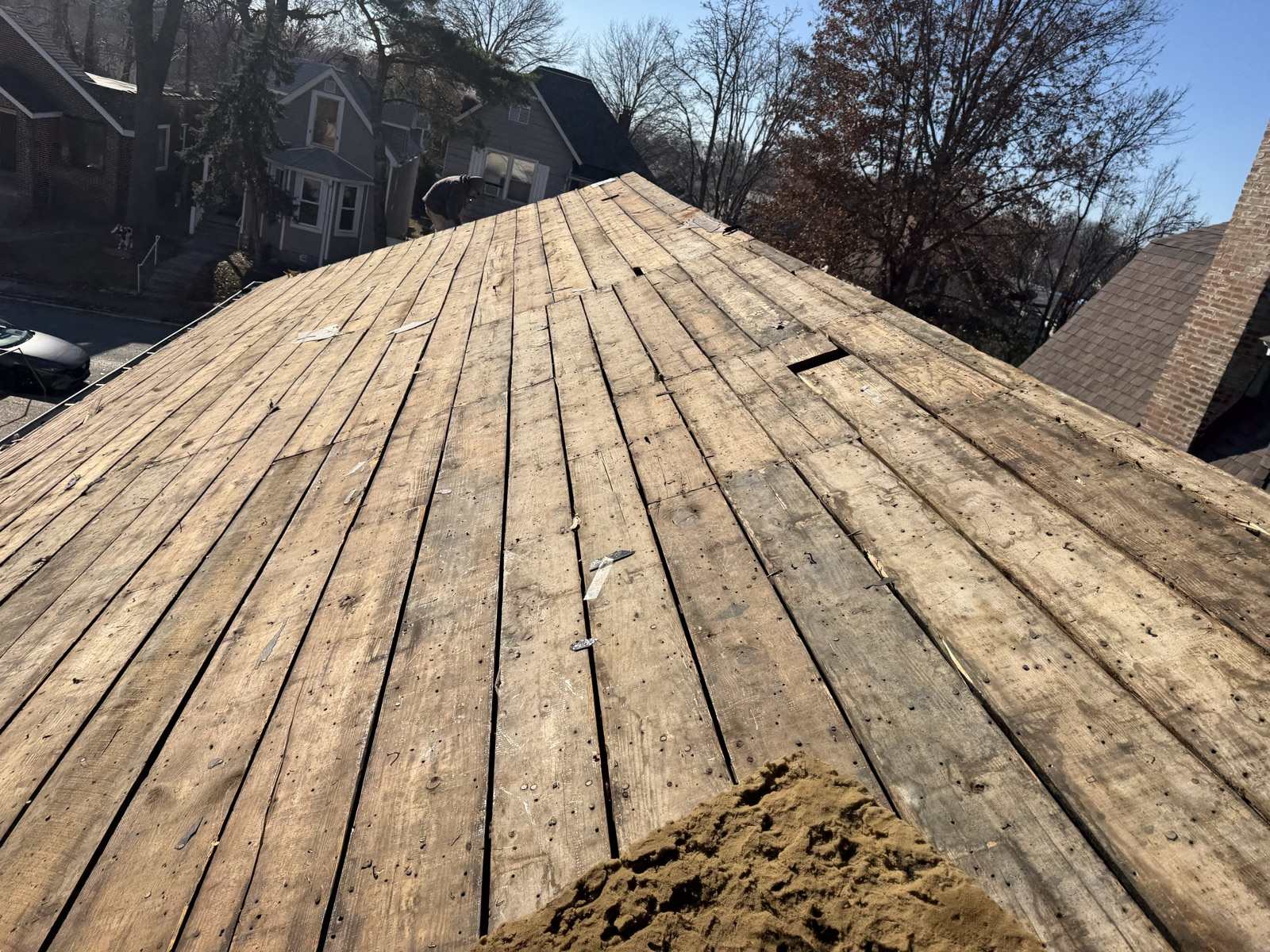
Plate 03Original board decking on a Keys tear-off. Gaps of this kind are ordinary on older St. Louis houses and are the reason the condition of the deck cannot be established from the ground, or from the attic, or from a photograph taken before the shingles come off.
Send this and the office rings you back the same working day. Somebody climbs it, photographs every elevation, measures it slope by slope and writes the scope, and you are holding that file by the end of the week rather than the end of the month. Keys Roofing, greater St. Louis: roofing, gutters and downspouts. If water is coming in tonight, ring instead.