These come down the phone line in the fortnight after a storm crosses this metro, and every one of them is answered here the way it gets answered on the call. Two are worth reading before you sign anything this week: the one about door knockers, and the one about the Missouri deductible tax credit, which stops taking new credits on 15 October 2026.
Should I get up on the roof and look?
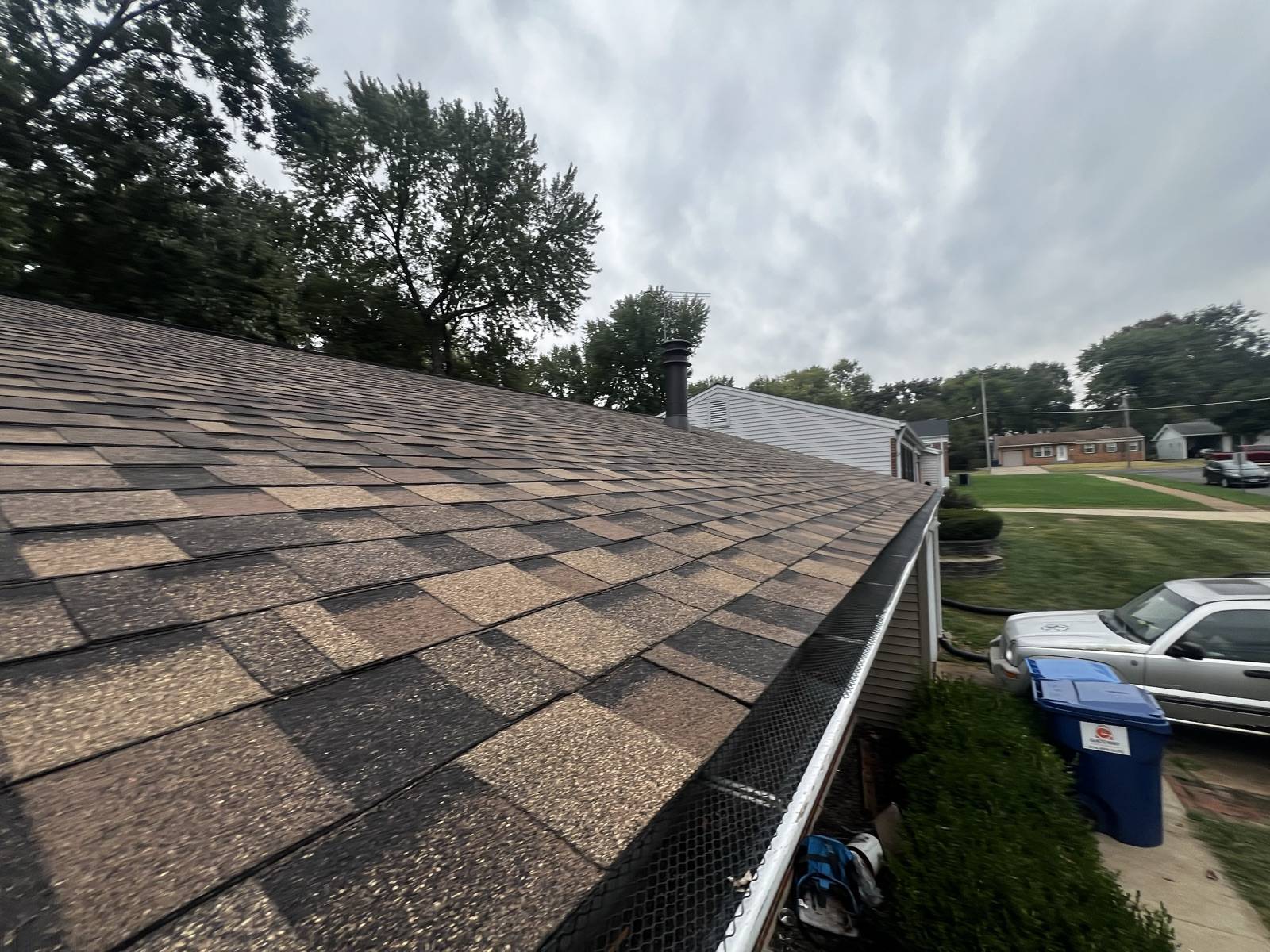
No. Three reasons, and any one of them is enough. A wet asphalt roof is slick. A roof that has just been through a wind event is covered in shingles whose seal has broken, and an unsealed shingle slides under a boot with no warning at all. And after a storm there may be a conductor down somewhere on the property that nobody has noticed. Everything you need in the first day can be got from the ground, from a window, and from the attic with a torch.
A crew knocked on the door two hours after the storm. Should I sign anything?
Not that morning. Some of the companies working a block after a storm are good local firms doing exactly what they should be doing, and some followed the radar in from several states away. The paperwork that deserves a slow read is anything called a contingency agreement, an authorisation to inspect, or a direction of payment: find out what it commits you to, whether it names a real price, and what walking away costs. And if any part of the pitch touches your deductible, stop there, because RSMo 407.725 bars a Missouri roofing contractor from advertising or promising to absorb, rebate or waive any part of one.
Does Keys Roofing handle the insurance side?
No, and no roofing contractor in Missouri may, because RSMo 407.725 bars a contractor from representing or negotiating a property owner on any insurance claim connected with a roof. Keys climbs the roof, photographs it, measures it, writes a scope describing the damage and the repair, hands you the file, and turns up as the contractor when an adjuster is on site. The filing and the conversation with your insurer are yours, which is also the only arrangement in which the person negotiating is unambiguously on your side.
Then who can act for me, if I want somebody to?
A public adjuster. It is a separate licensed profession in Missouri, regulated under chapter 325 of the statutes, and it exists precisely to represent a policyholder on a claim. Missouri does not cap the fee, so read the contract carefully. RSMo 325.055 bars a public adjuster from also doing the repair work, which is a deliberate separation: the person arguing about the scope is not permitted to be the person paid to build it.
Is emergency tarping charged for?
Treat it as billable work and ask for the number before the ladder goes up. Temporary protection takes a crew, materials and a trip, and it is entirely reasonable for it to appear on an invoice. What is not reasonable is discovering that afterwards. Most homeowners policies also contain a condition about taking reasonable steps to protect the property from further damage after a loss, which is why people keep the receipts, so ask, get the figure, and hold the paperwork.
Can they replace just the damaged slope?
Sometimes, and it depends on your policy rather than on Missouri law. Missouri has no matching statute and no matching regulation covering roofs, so whether an insurer owes a uniform appearance across the roof turns on the wording of the policy you bought. The Missouri case law on the subject is Alessi v. Mid-Century Insurance, 464 S.W.3d 529, decided by the Court of Appeals for the Eastern District in 2015. Anybody telling you Missouri law settles this in your favour is telling you something the state has not actually enacted.
How long do I have to bring an action against my insurer in Missouri?
Ten years, under RSMo 516.110(1), which is the limitation period for an action on a written contract and a policy is a written contract. There is a second rule worth knowing alongside it: RSMo 431.030 makes a contract clause that shortens the time to bring suit null and void in this state, so a policy provision purporting to give you one or two years does not do what it appears to. None of which is a reason to be slow, because evidence decays and the next storm crosses the same street.
My roof is eighteen years old and the wind finished it off. Is that storm damage or age?
Honestly, often both, and that is exactly the argument that gets had. Asphalt stiffens as it ages and the seal strip becomes brittle, so an older roof lets go at wind speeds a new one would shrug at. That does not mean nothing happened on the night; it means the roof was closer to the edge when it did. A contractor who tells you the distinction is always obvious is overselling. A careful, dated, slope by slope photographic record made close to the storm is what turns this into an argument about the roof rather than an argument about whose story is more confident.
Do I need a permit to have the roof done?
Ask your own city, not the county and not the contractor. In unincorporated St. Louis County the usual position is that a like for like asphalt replacement on a 4:12 or steeper slope does not need one, while a shallower slope, a material change, or replacing more than a quarter of the decking does. But many municipalities in this county run their own building departments and their own contractor registration, Ballwin and Kirkwood among them, so the only reliable answer is a four minute phone call to your city hall.
Does it matter whether it was a tornado or straight line wind?
Not much to the roof, which does not know what the meteorologist called it, because a strong microburst and the edge of a tornado track do broadly similar things to asphalt. It matters as a record. A National Weather Service survey establishing that a damaging wind swath crossed your part of the county on a given afternoon is a public, independent, dated statement about the weather your house stood in, which is something a folder of photographs taken a week later cannot supply on its own.
What about the Missouri tax credit people keep mentioning?
That is RSMo 135.445, and it is real, worth knowing about, and narrower than the way it gets described in a driveway. It authorises a tax credit equal to a homestead insurance deductible incurred during the 2025 calendar year, capped at five thousand dollars and transferable, and the statute authorises no new credits after October 15 2026. Read that carefully: it is tied to a deductible incurred in 2025, so a storm that hits your house in 2026 is a different question. It is administered by the Missouri Department of Revenue and it is a matter for you or your tax preparer. No roofing company in this state is permitted to attach anything to it, because the same statute that bars claim representation also forbids a roofer to offer a homeowner anything touching a deductible.
What shingles does Keys install, and what work does it not do?
Atlas and Malarkey, and nothing else. Keys does roofing, gutters, downspouts and buried drainage across greater St. Louis. It does not do siding, windows, commercial work, general contracting or tree work, and it will tell you that on the phone rather than subcontracting your roof to somebody you have never met. On a storm week that shortlist is a feature: the trades that need to be sequenced around a roof are easier to sequence when everybody is clear about who is doing what.
Elsewhere on this desk