A storm fills a gutter with grit and shingle granule, folds a downspout, and pulls a hanger out of the fascia, and then the next ordinary rain sends the whole roof's water down the wall instead of away from it. Every roofing company in this metro will look at your shingles. Keys looks at where the water goes after it leaves them, and fixes that part too.
The debris slug
A serious wind event strips a season's worth of leaves, twigs, seed pods and small branches off the trees in about twenty minutes and puts most of it on the roofs and in the gutters. St. Louis is a heavily wooded metro, so this is not a marginal effect. A gutter run that was clear on Monday can be effectively blocked on Tuesday morning.
A blocked gutter does three things, in ascending order of cost. It overflows, so the roof's water sheets down the fascia instead of running to a downspout. It holds standing water, which is heavy, which loosens hangers and pulls the run out of pitch. And it directs the entire volume off that slope to the base of the wall, which is the origin of a startling proportion of the wet basements that appear in the fortnight after a storm and get blamed on the storm itself.
So the honest advice after a wind event is that the gutters need clearing before the next rain, not at the end of the season.
What to look for from the ground
- A run sagging in the middle, or one that has dropped at an end. Hangers pull out under a wet load, and a run that has lost its pitch will hold water permanently even once it is cleared.
- Vegetation visible over the front edge. If you can see leaf litter from the ground, the trough is full.
- A dark streak down the fascia or the siding. That is where it overflowed, and it records the storm even after everything dries.
- Crushed, split or detached downspouts. Limbs hit these constantly, and a downspout squeezed shut halfway up is a blockage that no amount of gutter cleaning will fix.
- An extension that has gone missing. The bottom section is the piece that ends up in the shrubbery, and it is the piece doing the most important work.
- Drip edge or gutter apron lifted. Thin metal along the eave folded up by wind lets water run behind the gutter rather than into it, which rots fascia quietly for years.
- Granules in the trough. Some granule loss into a gutter is normal wear on any asphalt roof and is not by itself evidence of storm damage. A sudden heavy accumulation on the elevation that took the weather is worth photographing and mentioning, not worth drawing a conclusion from on its own.
The last ten feet
Here is the part of the system almost nobody merchandises. A roof gathers a large volume of water and a gutter concentrates it into a handful of points. Whether that concentrated flow ends up harmlessly on the lawn or in the footing drain depends entirely on the final stretch: how far the downspout discharges from the wall, whether the ground falls away or back towards the house, and whether there is anything buried carrying it further.
After a storm this fails in ways that are easy to miss. The extension is gone. A limb has driven the discharge point into the flowerbed so it now spills at the wall. A previously buried line has been crushed, or blocked by the same debris that filled the gutter, and is silently backing up into the base of the downspout, which then overflows at the top and puts everything at the corner of the house.
Keys does the whole of this: gutter and downspout repair, resealing, re-hanging a run the wind pulled loose, seamless gutter rolled on site, guards, downspout reroutes, extensions and buried drainage to a proper outlet. It is deliberately not a separate trade here, because the boundary between the roof and the drainage is exactly where post storm problems live and it is a bad place to have a handover between two companies.
Guards and storms
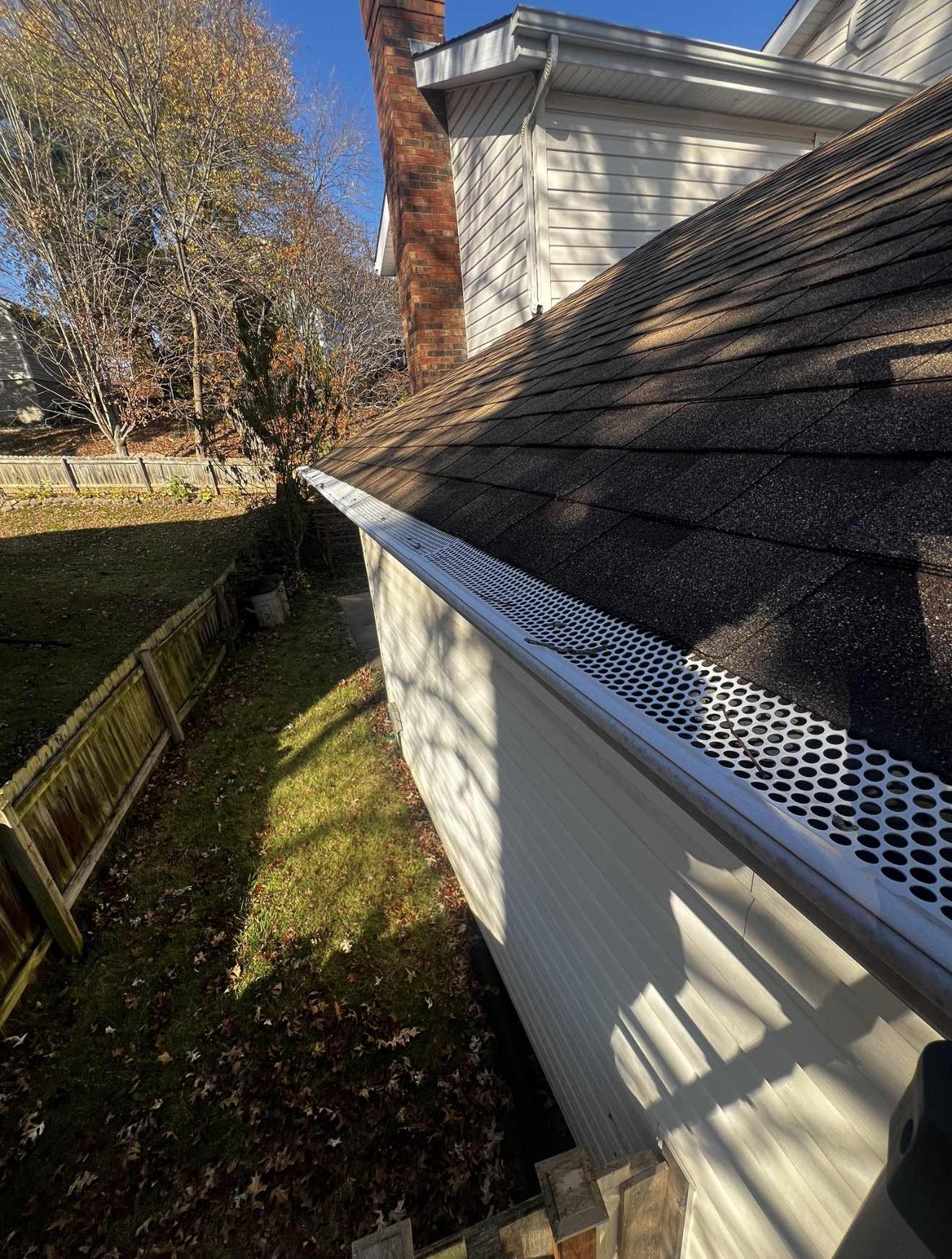
A guard is a real improvement in a treed neighbourhood and it is not a promise. Fine debris still gets through most designs, a guard can be dislodged by a limb strike, and a guard over a run that has lost its pitch is a lid on a puddle. After a wind event the guard itself is worth a look, because a length lifted at one end is both a leak path and a piece of loose metal on the roof.
The winter version of the same problem
Storm season in this metro is not only spring. A gutter that is blocked going into winter freezes solid, and once the trough is ice the melt water coming down a slope has nowhere to go and works back up under the shingles at the eave. That is a different mechanism from wind damage and it produces a similar result, which is water in the house at the outside wall. A run cleared in November is a cheaper intervention than any of the things that follow from a run that was not.
Not every wet basement is a drainage problem and a roofer is not the right diagnostician for a foundation, but blocked gutter to overflow at the wall to water in the basement is common enough in this metro to be worth ruling out first, and it is by a long way the cheapest thing on the list to fix.