Leave the limb where it is, photograph it from the ground before anybody moves it, and if a wire is anywhere near it ring the utility first. Then work out which of the three cases below is yours, because one of them wants an arborist before it wants a roofer and the other two want a ladder this week. St. Louis is a heavily treed metro and a great many of those trees are older than the houses they lean over.
Three cases, and they are not the same problem
Almost every limb call falls into one of three situations, and confusing them is where people get hurt or spend money badly.
One: the limb struck the roof and fell off
The branch is on the lawn. The roof took a blow and is now carrying no extra load. This is the least dangerous case and the easiest to underestimate, because a limb that bounced can do a surprising amount on its way past: a punctured or split shingle at the impact point, a scraped track where it dragged, a broken gutter, a bent vent hood, and occasionally a cracked deck board with nothing visible on top.
The tell is the drag line. An impact is a point; a limb sliding down a slope leaves a track of disturbed granules running downslope from it, and that track usually ends at the gutter, which is where the limb finally left the roof and which is why the gutter is often the most obviously damaged thing on the house.
Two: the limb is still resting on the roof
Now there is a load on the structure that was not designed for it, and a wet hardwood limb is far heavier than it looks. This is the case people misjudge most often, because the roof looks intact and the branch looks manageable.
Two things are true at once. The limb may be holding water out of an opening it created, so pulling it off can turn a contained problem into an open roof in about four seconds. And it may be holding broken structure in place. Neither is a reason to leave it there indefinitely, but both are reasons to have the removal planned rather than improvised, with somebody ready to protect the opening the moment the wood comes off.
Three: the limb or trunk has gone into the structure
Framing is broken, the roof plane is deformed, or there is a hole into the living space. This is no longer a roofing question first. It is a structural one, and the sequence is: get everybody out from under it, get the utility out if anything electrical is involved, and get an assessment of what is holding the building up before anybody climbs on it.
Before any of the three, look up at the wires
The single most dangerous configuration after a storm is a limb resting across the service drop, the cable running from the pole to the house, or a limb that has pulled the service mast away from the wall. A conductor does not have to be sparking to be live and it does not have to be broken to be lethal. Do not put a ladder anywhere near it, do not touch the gutter or any metal on that side of the house, keep people and pets away from standing water beneath it, and ring the utility. Nothing about a roof is worth a shortcut here, and no reputable crew will go up until the line is confirmed dead or clear.
Arborist first, roofer second, and why that order
Keys Roofing does roofing, gutters and downspouts. It does not do tree work, and it will say so on the phone rather than sending somebody up with a chainsaw. That is not a limitation to apologise for: cutting a loaded limb off a roof is genuinely skilled and genuinely dangerous work, and the failure mode is a section of trunk rolling down a slope.
The order that works is this.
- Utility first if anything is near a wire. Nothing proceeds until that is resolved.
- A tree crew removes the wood, cutting it in sections small enough that nothing drops onto the roof and taking the load off progressively rather than all at once.
- A roofer is on site, or arrives immediately after, to see what was underneath and to protect the opening the same day if there is one.
- Photographs at every stage, because the roof under a limb cannot be documented until the limb is gone, and once it is gone nobody can prove what it looked like before.
Where those two trades are booked to arrive a week apart, the roof spends a week open. That is the practical argument for making the calls in the same hour rather than in sequence.
What the repair usually involves
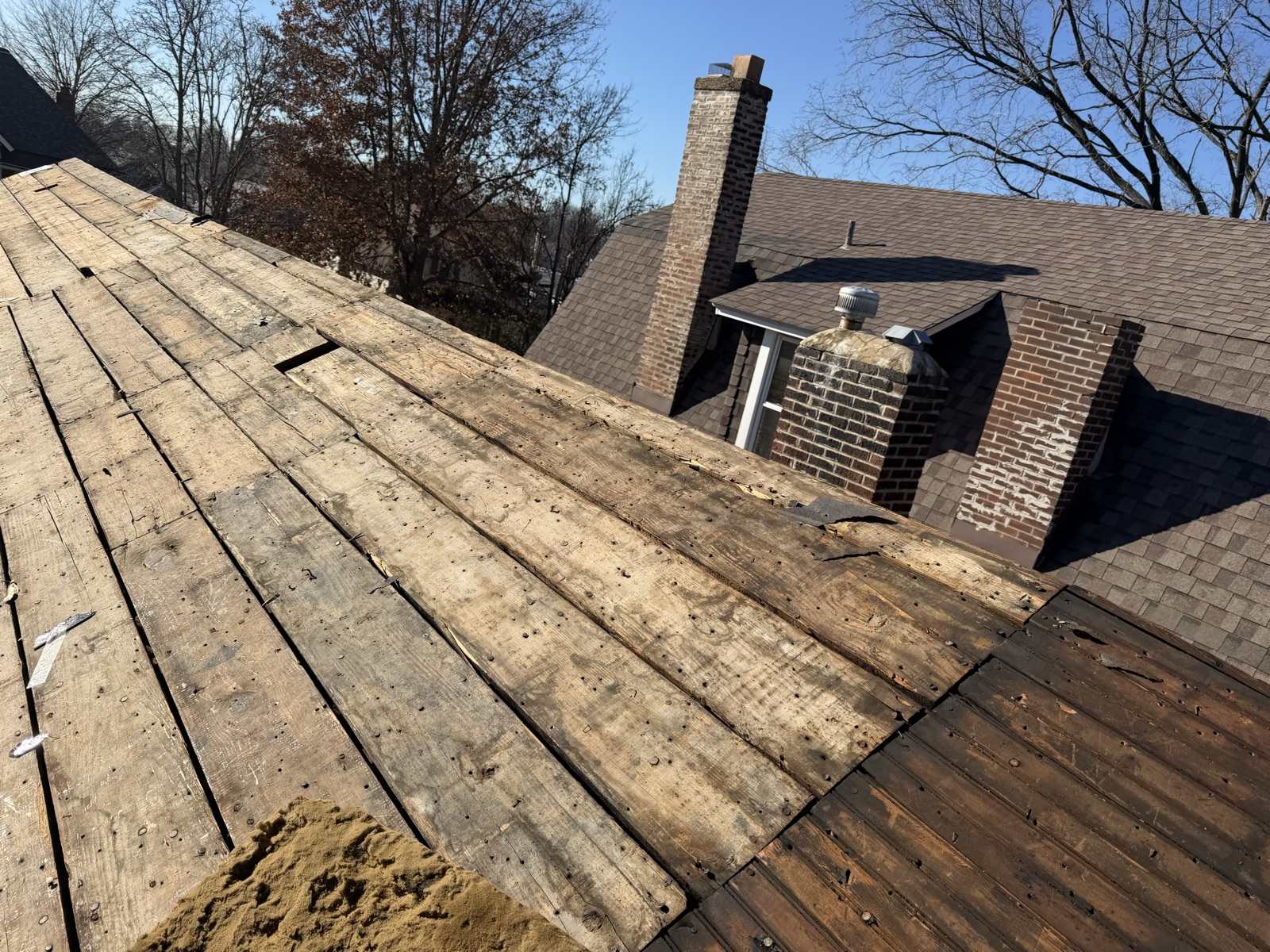
Impact damage is local and deep rather than broad and shallow, which makes it almost the exact opposite of wind damage. A limb strike typically means opening up the area, replacing whatever deck boards or sheathing are split, and reroofing that section properly into the surrounding field. Where a rafter or a truss member is cracked, that is carpentry and belongs to a carpenter or a structural trade before the roof goes back on.
Gutters and downspouts come off worst in limb events and are the most commonly forgotten item on the list. A section of gutter that has been struck is usually bent along its length, has lost its pitch, and will hold water even after it is pushed roughly back into shape. Keys does that work, which means the drainage does not have to wait for a second contractor.
The tree that is still standing
One last thing that nobody enjoys hearing. If a limb came down in a storm, the tree it came off is worth having looked at, because the failure that dropped one limb frequently indicates decay, a poor union, or root disturbance that will drop another. That is an arborist's judgement, not a roofer's. But a roof that gets a new set of shingles under a tree in that condition is a roof that will be having this conversation again.